
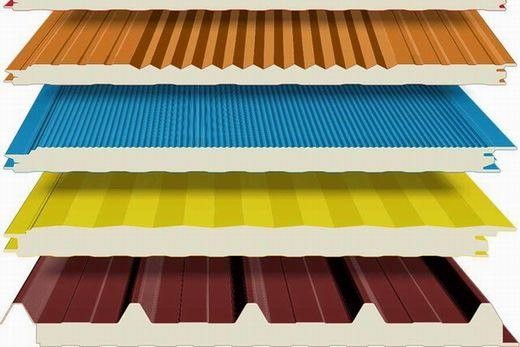
Sandwich panel production lines for polyurethane are divided into two types: continuous production lines and discontinuous (batch) production lines.
Continuous production lines are designed for manufacturing polyurethane sandwich panels in such a way that the top and bottom steel sheets of the panel are movable along the line. As the sheets move, polyurethane foam material is injected horizontally and transversely between the moving sheets.
In the polyurethane foam injection section, raw materials including continuous-grade polyol and isocyanate are combined with other components such as a blowing agent and a catalyst, and then injected between the steel sheets.
In continuous sandwich panel lines, the foam-coated steel sheets are mobile and are transferred beneath pressing rollers. The thickness determined between the rollers defines the thickness of the produced panel.
It is worth mentioning that the length of the pressing rollers in continuous sandwich panel machines ranges from 10 meters up to over 30 meters, and the thickness of the produced panels varies from 3 centimeters to over 15 centimeters. Therefore, the continuous-grade polyol materials must possess specific characteristics to ensure compatibility with various production lines and to deliver high-quality final products.
Below are the technical specifications of Razin Company’s continuous-grade polyol.
Technical Features of Razin’s Continuous-grade Polyol
As indicated by the technical features, producing this grade of polyol involves technical complexity. Razin Polyurethane Company, utilizing its experienced R&D team, has succeeded in manufacturing, stabilizing, and obtaining customer approvals for this product.
Applications of Polyurethane Foam Made from Continuous-grade Polyol
Razain Company’s Continuous-grade Polyol Grades
In the panel products section, two grades, 300 and 302 Razapol, are offered in unfoamed form. Grade 300 Razapol meets B3 standards, while Razapol 302 meets B2 standards. These grades, containing 10% cyclopentane gas and an appropriate amount of catalyst DMCHA (depending on the length of production lines), are used to produce continuous panels with thicknesses of 4, 8, 10, and 15 centimeters.
Why Choose Razin’s Polyol
High Quality:
Utilization of premium raw materials, advanced technical knowledge, and precise quality control systems.
High Compatibility:
The variety of grades and their technical features make Razin’s raw materials suitable for diverse production lines.
Technical Support:
Providing consultation and after-sales services to ensure the production of high-quality polyurethane foam.
Cost-Effectiveness:
Despite competitive pricing, the raw materials are designed to achieve high quality and suitable density with minimal raw material consumption.